
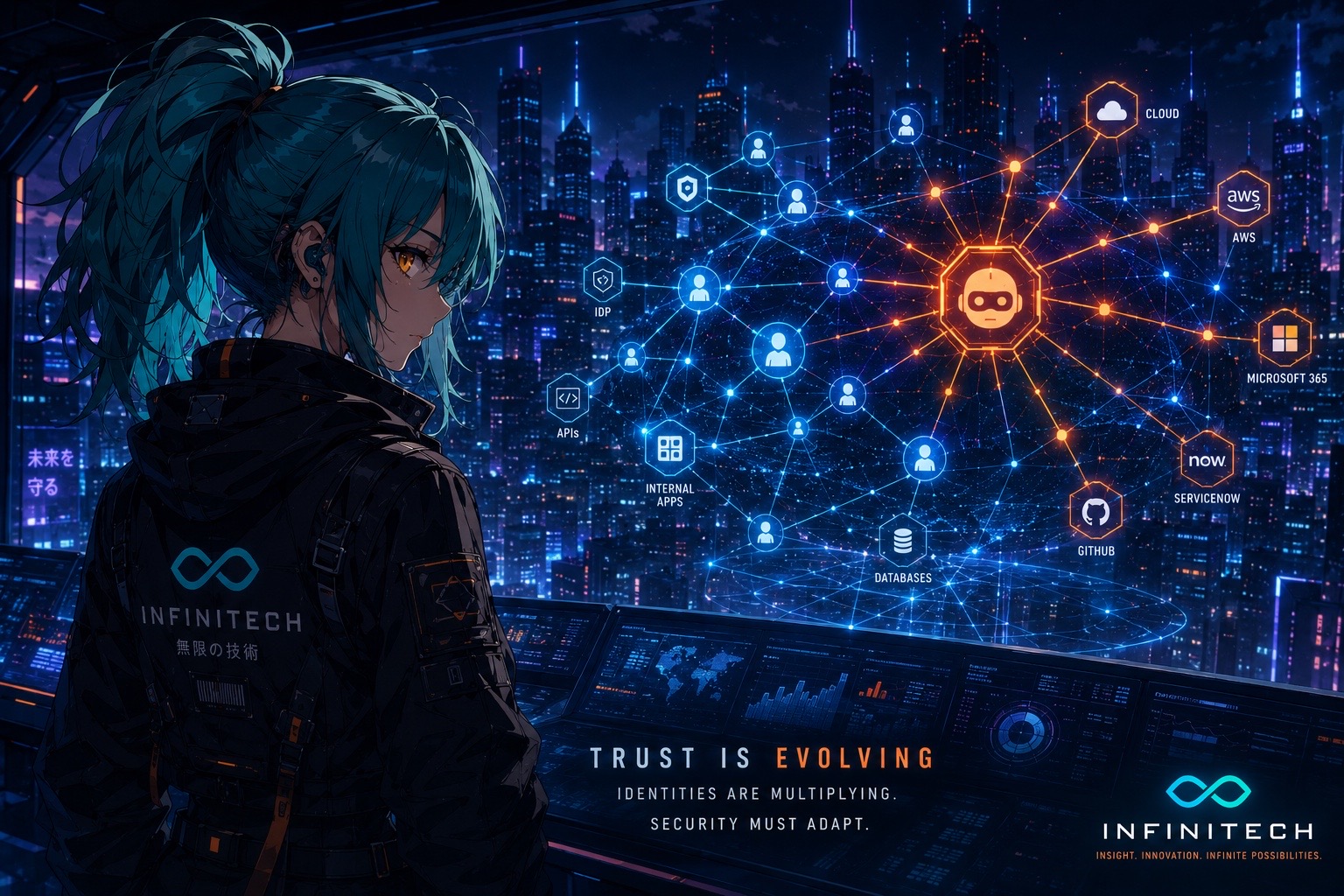
Let’s cover why the rise of AI agents is forcing us to rethink trust, identity, and security from the ground up.
For years, cybersecurity has been centered around one question:
How do we protect people from attackers?
It’s a question that has shaped everything from password policies and endpoint protection to phishing awareness training and Zero Trust architectures.
But technology has quietly crossed a threshold.
Artificial intelligence is no longer limited to answering questions, summarizing documents, or generating code. Today’s AI is beginning to act on our behalf. It can access applications, execute workflows, analyze data, write software, open support tickets, interact with APIs, and increasingly make decisions with little or no human intervention.
That’s not just another technology trend.
It’s a fundamental shift in how work gets done.
And with that shift comes an entirely new security challenge.
The next cybersecurity battle won’t be fought by humans alone.
It will be fought over autonomous identities.
AI Is Becoming a Participant, Not Just a Tool
For years, we’ve treated AI like software. You asked a question…it gave an answer. Crazy simple, but that model is disappearing.
Modern AI agents are designed to complete objectives rather than simply respond to prompts. Instead of asking for the next instruction, they can chain together actions, retrieve information from multiple systems, communicate with other services, and continue working until a task is complete.
Think about what that means inside an enterprise.
An AI assistant might:
- Access Microsoft 365 to gather information.
- Query a CRM for customer data.
- Create or update ServiceNow tickets.
- Generate and review source code.
- Deploy cloud infrastructure.
- Analyze security alerts.
- Coordinate tasks across multiple business applications.
Each one of those actions requires trust and access. Also, each one creates a new identity that must be secured.
The Security Conversation Is Changing
For decades, cybersecurity has focused on protecting human users. Today, organizations manage employees, contractors, vendors, administrators, service accounts, and machine identities.
Now we must account for something entirely new.
AI agents.
Unlike traditional service accounts, AI agents are dynamic. They make decisions, request resources, and interact across multiple environments. This creates difficult questions that many organizations are only beginning to ask.
Who owns an AI agent? Who determines what it should have access to? How much autonomy is acceptable? How do you audit decisions made by software acting independently?
Perhaps the most important question of all:
What happens when an attacker compromises an AI identity instead of a human one?
The New Attack Surface
Cybercriminals rarely attack technology simply because it exists. They attack whatever provides the fastest path to valuable data and privileged access. So If an AI agent has permission to interact with cloud platforms, collaboration tools, internal documentation, ticketing systems, or production environments, compromising that identity becomes incredibly valuable.
The attack is no longer centered on convincing an employee to click a malicious link. Instead, attackers may attempt to manipulate or compromise systems that already possess legitimate access.
This changes how we think about risk.
The challenge is no longer just preventing unauthorized access. It’s continuously validating authorized access.
Why Identity Has Become the New Perimeter
For years, organizations invested heavily in protecting the network perimeter.
Firewalls became stronger. Endpoint protection became smarter. Detection tools became faster. But today’s enterprise rarely operates behind a single perimeter.
Applications live in multiple clouds.
Employees work remotely.
APIs connect hundreds of services.
Business processes span dozens of platforms.
Identity, not location is becoming the primary control point.
This is why concepts like least privilege, continuous verification, microsegmentation, and visibility matter more than ever.
Trust can no longer be granted once. It must be earned continuously.
Visibility Matters More Than Ever
One lesson has become increasingly clear throughout the cybersecurity industry:
You cannot secure what you cannot see.
Organizations often maintain detailed inventories of servers, endpoints, and applications while overlooking the relationships between them.
Who talks to what?
Which identities have excessive privileges?
Where is sensitive information flowing?
Which AI systems are interacting with production environments?
Without visibility, security becomes reactive.
With visibility, security becomes intentional.
Understanding these relationships will become one of the defining capabilities of modern cybersecurity teams.
The Professionals Who Adapt Will Define the Next Decade
Technology has always rewarded those willing to evolve.
This moment is no different.
The cybersecurity professionals who thrive over the next decade won’t simply memorize tools or earn certifications.
They’ll understand how AI, identity, cloud architecture, automation, and security intersect.
They’ll ask different questions.
Not:
“How do we stop AI?”
But:
“How do we securely enable AI while maintaining trust?”
That’s a much harder problem.
It’s also a far more valuable one to solve.
Looking Ahead
Artificial intelligence isn’t replacing cybersecurity.
It’s expanding it.
Every advancement introduces new opportunities—and new responsibilities.
The organizations that succeed won’t necessarily be the ones with the most AI.
They’ll be the ones that understand how to govern it, secure it, and build trust around it.
We’re entering an era where identities may no longer belong exclusively to people.
Some will belong to software.
Some will belong to autonomous agents.
Some may even belong to systems that collaborate with one another without direct human involvement.
The question isn’t whether this future is coming.
It’s already here.
The real question is whether our security strategies are evolving quickly enough to keep pace.
Final Thoughts
I’ve spent the past several months immersed in enterprise security, observing how quickly the landscape is changing from the inside. That time reinforced something I’ve believed for years: cybersecurity is no longer just about defending systems. It’s about understanding how technology, identity, and trust evolve together.
This marks the beginning of a new chapter for Infinitech.
In the coming weeks, we’ll explore topics like agentic AI, non-human identities, microsegmentation, Zero Trust, cloud security, and the architectural shifts redefining enterprise defense.
The next generation of cybersecurity isn’t waiting for us.
It’s already being built.